Provide life-changing support that adapts to individual student needs
Published:

Kamna Gupta
Sales and Business Development Manager - DSA

In lectures, disabled students are often expected to listen, process, decide what matters and write, all at the same time. Here's why that creates barriers, and how you can help students overcome them.
The problem
Let's take a moment to think about what a student has to do during a lecture.
They have to listen, understand the information, decide what is important and write it down, all at the same time. For many disabled students, this can overwhelm their working memory. As a result, important information can be missed before they have the chance to write it down.
This is explained by Cognitive Load Theory, which was developed by John Sweller in 1988. When the brain has to manage too many tasks at once, there is not enough mental capacity left to take in all the information. Many disabled students also experience mental fatigue and changes in attention during lectures. As a result, students with learning disabilities often record far fewer lecture points than their peers (Hughes & Suritsky, 1994).
For these students, traditional note taking can present many barriers to learning. But there are ways to provide support that helps with these challenges.
Every student is different
The barriers a student with dyslexia faces aren't the same as those facing a student with ADHD, a student with a physical disability, or a student with anxiety. The key is to provide support built to flex around those individual needs rather than assuming every disabled student needs the same kind of support.
In practice, this means you can help reduce the specific barriers that get in the way, whether that's cognitive overload, difficulty concentrating, or slow writing speed. When you recommend personalised learning support like Jamworks, you are giving students a toolkit to turn lectures into structured material so they can build lasting knowledge.
You can help facilitate this across three stages:
Prepare - before class
Capture - during class
Study - after class
Before class - Prepare
We often assume that students come to a lecture without looking at the material first, and for many students that is the case. However, when learners engage with the material beforehand, they understand more during the lecture (van Alten et al., 2019). They can build on what they already know, instead of trying to understand everything for the first time under pressure.
This is explained by schema theory. When we are already familiar with a topic, our brains have existing structures that help us connect and understand new information (Bartlett, 1932). Without these structures, new information is harder to understand and remember. This is why what a student already knows has such a strong effect on how well they learn something new (Dochy et al., 1999).
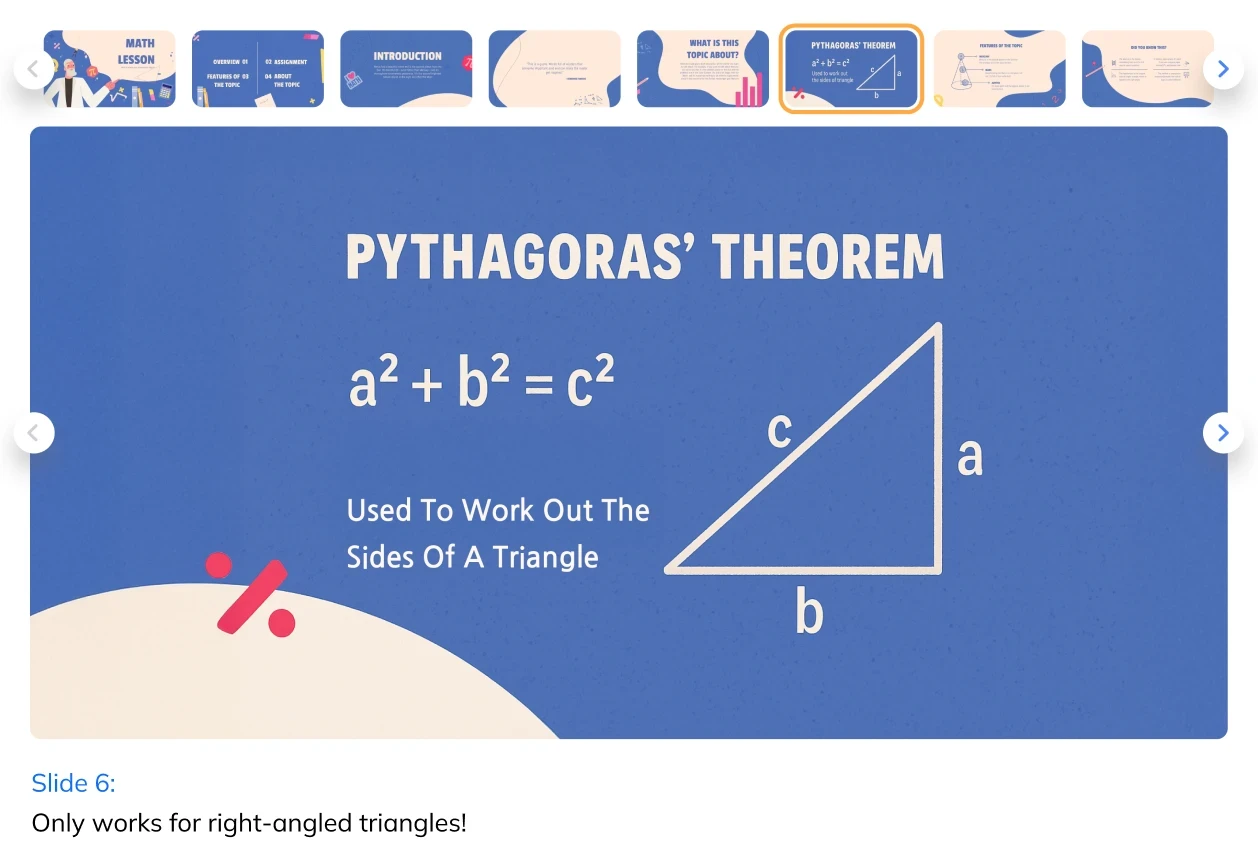
Providing Jamworks helps your students to prepare before a lecture. They can upload PDFs, reading materials or lecture slides and receive a clear summary of the content, along with the most important points. They can then annotate on the material they upload, add their own notes and use JamAI to ask questions, explore anything they do not understand and work through the material in their own words and at their own pace.
For disabled students, this has two important benefits. First, being familiar with the content reduces the mental effort needed during the lecture. This means students can focus more on understanding the information instead of simply trying to keep up (Sweller, 1988). Second, for students who experience anxiety, feeling prepared can reduce the uncertainty and stress that often make it harder to engage.
During class - Capture
The lecture itself is often where the biggest barriers appear.
Imagine a student with dyslexia in a fast-paced lecture. Writing quickly while trying to listen and understand can make note taking feel impossible. As a result, many students quietly stop trying. For students with ADHD, listening and writing at the same time can place even more pressure on working memory that is already stretched (Jacobson et al., 2011). What may look like a student switching off is often a sign that they have reached their processing limit.
Providing Jamworks supports students in several ways, starting with recording. Students can record the lecture, removing the pressure of listening and writing at the same time in order to capture everything. Instead, they can focus on understanding what is being taught, safe in the knowledge that they will be able to revisit everything in easy to digest formats afterwards.
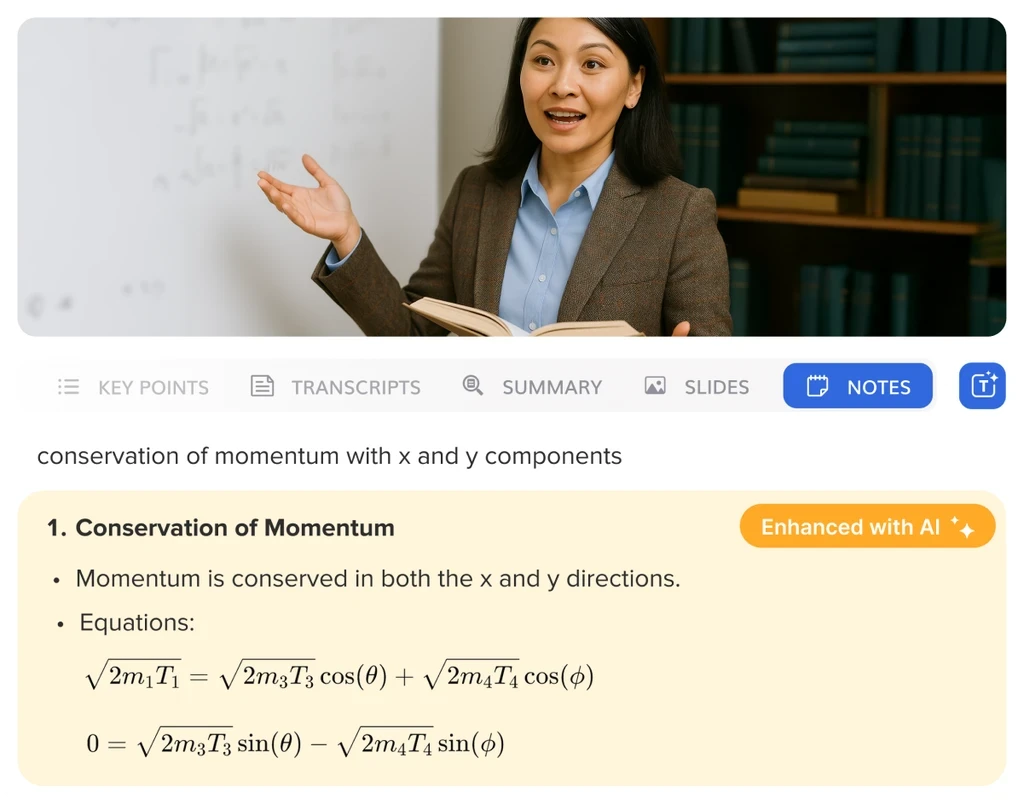
Students who prefer to take notes can write at a comfortable speed as they go. Later on, they will receive suggestions to improve and develop their rough timestamped notes into a more complete set of study notes. If a student cannot write during the lecture due to physical impairments, they can simply listen, knowing that neatly formatted notes will be available afterwards.
Students can also mark important moments while recording. Each moment becomes a timestamped highlight that they can return to easily. Jamworks captures these moments as short audio clips and turns them into bite-sized summaries after the lecture. This is especially useful for students who experience brief lapses in attention and need a quick way to return to something they missed.
Students can also upload their lecture slides and write notes alongside each one. This keeps the slides and notes together, so students do not have to keep switching between different windows.
For students with hearing needs, live captions provide vital access to the information discussed in the lecture. The captions are divided into paragraphs instead of appearing as one long block of text, making it easier for students to follow and keep their place. Students can also adjust the text size to make the captions comfortable to read.
Students can also ask questions during the lecture. If they miss a piece of jargon or do not understand an acronym, they can type a question and receive an answer straight away without raising their hand. For students who find it stressful to ask questions in front of the class, this can make a real difference.
After class - Study
Once the lecture ends, the challenge shifts from capturing information to understanding, organising and remembering it.
Many students revise by repeatedly reading through their notes. It feels productive because the information becomes more familiar, but familiarity is not the same as learning. Research consistently shows that re-reading has limited value for long-term retention, while active recall, trying to retrieve information from memory, is far more effective (Roediger & Karpicke, 2006; Dunlosky et al., 2013; Yang et al., 2021).
If you want to help students turn the content captured during a lecture into something they can actively study from, Jamworks provides some really useful tools to make this happen.
For students who wrote their own notes, Enhanced Notes suggests improvements, fills in missing information and turns rough notes into a clear, structured study document based on the lecture itself.
For students who were unable to take notes during class, Key Points identifies and summarises the most important information. This gives them a manageable starting point instead of facing an empty page or a long transcript.
For STEM students, Jamworks accurately formats equations and formulas across Enhanced Notes, Key Points and summaries, including any notation that was missed from their original notes. This is particularly important in STEM subjects, where even a small error can completely change the meaning.
Students can then generate flashcards and quizzes from their own lecture content. Instead of reading the same information again, they can practise retrieving it from memory and identify the areas they have not fully understood.
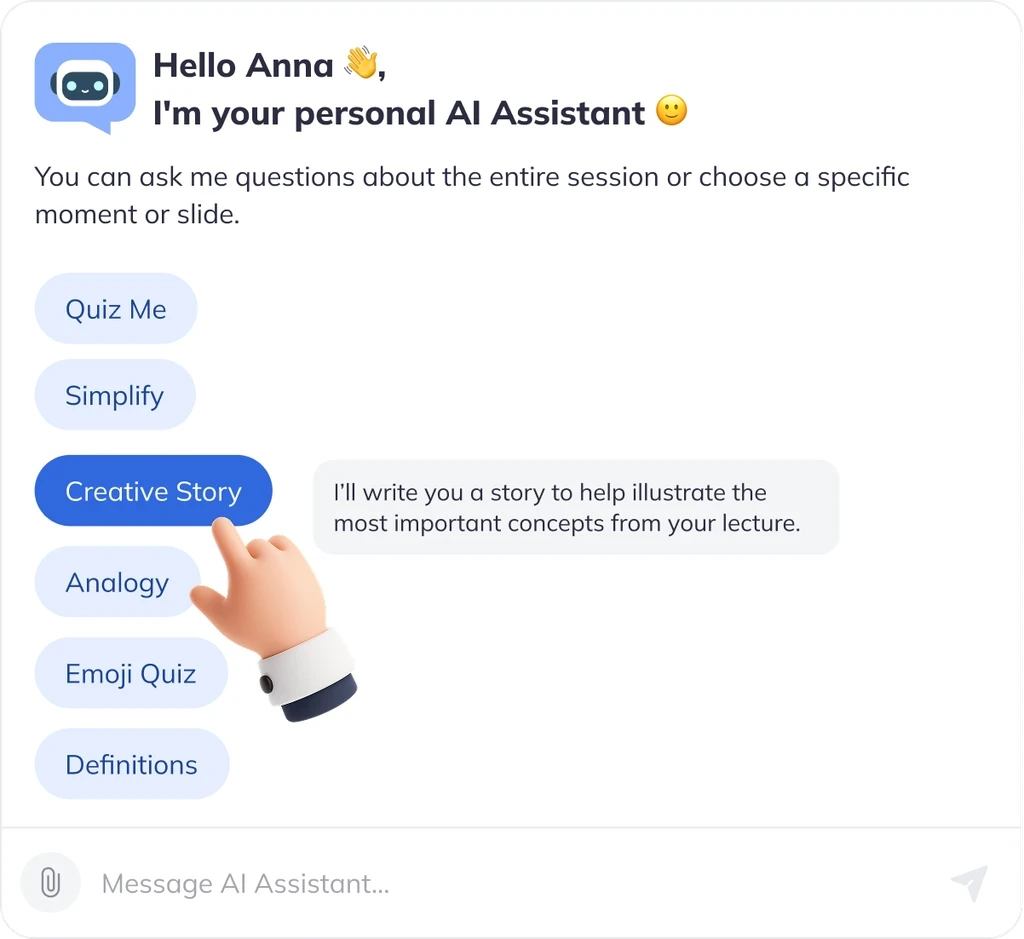
If something still does not make sense, students can ask JamAI questions about their lecture recording or slides and receive a clear explanation personalised to the material they are studying. This gives students another way to get help, particularly when anxiety or a lack of confidence makes it difficult to ask questions during the lecture.
It is worth mentioning here that every study material that is generated by Jamworks comes straight from the transcript of the lecture or from the lecture slides uploaded by the student which means students are in a safe space and can confidently study from Jamworks for their exams.
Jamworks Notes and Captions
Jamworks Notes is approved for all DSA students who need note taking support and includes everything except live captions.
Jamworks Captions is approved for students who are Deaf or hard of hearing and adds live captions on top plus the ability to ask questions about live lectures.
What DSA students say about Jamworks
The impact of accessible learning is best understood through the experiences of students themselves.
One UK undergraduate with dyslexia had been considering leaving university because of the pressure she experienced when taking notes:
"The pressure of note taking with my dyslexia was a huge barrier, and I was honestly thinking about quitting higher education. Jamworks completely removed that stress. It gave me the confidence to not only continue but to apply for my master's degree. I have no words, it's amazing."
For Rebecca Clarke, a Biomedical Engineering student at King's College London, the impact extended beyond academics. Jamworks helped her feel more confident, independent and able to engage with her friends:
"Having the Jamworks summaries is enough to get me started and get me in the headspace of work. It makes the task more manageable and less overwhelming, improves your mental wellbeing and your grades. I don't know what I'd do without it.
I'm more independent when it comes to assignments because I have all the information myself. I'm even more independent emotionally. I'm less worried, so I can engage more with my friends. Jamworks has definitely reduced the pressure of note taking and revision."
These accounts show what accessible learning can make possible. What these students gain goes beyond captured information or better grades. They experience less pressure, more confidence, and real independence throughout their education.
When you provide Jamworks to a student, you provide them with support that could change their life.
References
Bartlett, F. C. (1932). Remembering: A Study in Experimental and Social Psychology. Cambridge University Press.
Dochy, F., Segers, M., & Buehl, M. M. (1999). The relation between assessment practices and outcomes of studies: The case of research on prior knowledge. Review of Educational Research, 69(2), 145–186.
Dunlosky, J., Rawson, K. A., Marsh, E. J., Nathan, M. J., & Willingham, D. T. (2013). Improving students' learning with effective learning techniques: Promising directions from cognitive and educational psychology. Psychological Science in the Public Interest, 14(1), 4–58.
Hughes, C. A., & Suritsky, S. K. (1994). Note-taking skills of university students with and without learning disabilities. Journal of Learning Disabilities, 27(1), 20–24.
Jacobson, L. A., Ryan, M., Martin, R. B., Ewen, J., Mostofsky, S. H., Denckla, M. B., & Mahone, E. M. (2011). Working memory influences processing speed and reading fluency in ADHD. Child Neuropsychology, 17(3), 209–224.
Roediger, H. L., & Karpicke, J. D. (2006). Test-enhanced learning: Taking memory tests improves long-term retention. Psychological Science, 17(3), 249–255.
Sweller, J. (1988). Cognitive load during problem solving: Effects on learning. Cognitive Science, 12(2), 257–285.
van Alten, D. C. D., Phielix, C., Janssen, J., & Kester, L. (2019). Effects of flipping the classroom on learning outcomes and satisfaction: A meta-analysis. Educational Research Review, 28, 100281.
Yang, C., Luo, L., Vadillo, M. A., Yu, R., & Shanks, D. R. (2021). Testing (quizzing) boosts classroom learning: A systematic and meta-analytic review. Psychological Bulletin, 147(4), 399–435.